China has become a significant sourcing base for outdoor furniture, including the Outdoor Teak Dining Table. Its manufacturers combine teak processing, metal fabrication, upholstery, and export logistics within established production clusters.
Grand View Research valued the global outdoor furniture market at approximately USD 19.8 billion in 2023. The firm also projects continued growth through 2030, supported by residential outdoor living and hospitality investment. IMARC Group reports similar expansion, although market estimates vary by research method. That difference deserves attention.
A strong supplier comparison should examine more than factory photographs. Teak origin, moisture control, kiln-drying procedures, joinery, stainless-steel grades, and surface finishing directly affect long-term performance. FSC certification can also support responsible forest management, but buyers should verify certificate numbers and product scope independently.
Richard Frinier, a recognized outdoor-living designer, has said, “Outdoor rooms are an extension of the home.” His observation explains why table proportion, edge comfort, visual balance, and maintenance requirements matter. A beautiful table can still fail when its legs rock on stone paving.
China’s leading suppliers may offer custom dimensions, umbrella holes, matching chairs, and private-label packaging. However, quality is not uniform. Sampling, factory audits, wood-moisture testing, and pre-shipment inspections remain practical safeguards. Ask for recent project references, not only catalog images.
This guide evaluates China’s top Outdoor Teak Dining Table suppliers through material transparency, manufacturing capability, export experience, customization, certifications, and after-sales reliability. Some supplier information may change. Rechecking every claim before purchase is sensible.
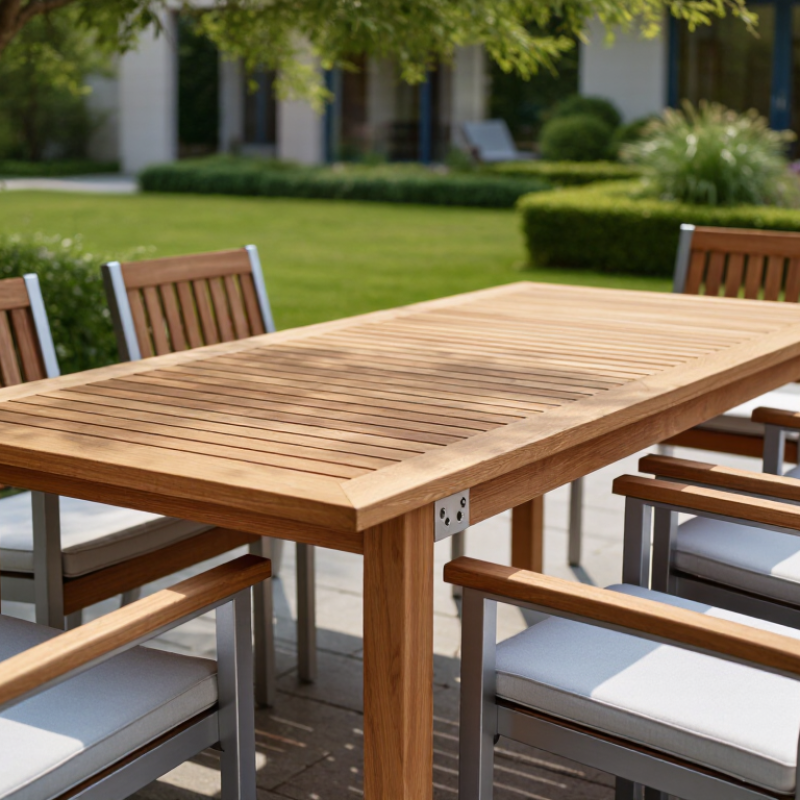
A top supplier understands that teak furniture is more than attractive wood. It must survive sun, rain, humidity, and repeated cleaning. Grand View Research reported that the global outdoor furniture market was valued at approximately USD 19.8 billion in 2023. This growth increases demand, but it also exposes weak manufacturing controls. A reliable supplier should explain teak grading, moisture content, kiln-drying methods, and joint construction without vague promises.
Ask for measurable evidence. The supplier should provide wood-origin documents, factory quality procedures, and batch inspection records. FSC Chain of Custody certification can support responsible sourcing, although certification alone does not prove excellent craftsmanship. Check table samples closely. Look for tight mortise-and-tenon joints, smooth edges, consistent gaps, and drainage-friendly design. Small details matter. A table that rocks on a showroom floor may fail faster outdoors.
Professional suppliers also test performance. ASTM and EN testing references can help evaluate load strength, coating durability, and weather resistance. The 2024 Houzz outdoor living trends report indicates continued consumer investment in outdoor dining areas, but design popularity should not replace engineering judgment. Some suppliers may over-dry teak, causing later movement. Others may understate natural color changes. That deserves questioning. Request production photos, pre-shipment inspection options, packaging specifications, and replacement policies in writing. Price remains important, but unusually low pricing may reflect thinner components, mixed wood grades, or limited quality control. Experience suggests patience is useful here. A polished catalog is not proof. A transparent process is stronger evidence.
High-quality outdoor teak dining tables begin with properly selected timber. Mature teak has tight grain, natural oils, and strong resistance to moisture, insects, and sunlight. Its surface should feel dense and smooth, without deep cracks, soft spots, or excessive filler. Even color is attractive, but natural variation is normal. A pale board is not automatically poor quality.
Construction matters as much as the wood. Look for reinforced joints, accurate alignment, and stainless steel hardware that resists outdoor corrosion. Table legs should sit firmly on level ground, while the tabletop needs enough clearance for rainwater to escape. A slightly rounded edge improves comfort and reduces splinter risks. I have seen beautiful tables fail because their joints were weak. Appearance can hide poor engineering.
Tips: Ask suppliers about timber origin, moisture control, and kiln-drying methods. Request close-up photos of joints, undersides, and hardware. Check the table’s weight and thickness, not only its advertised dimensions. A heavy tabletop often feels more stable, but excessive weight may complicate moving it. Teak can weather into a silver-gray tone without losing strength, although periodic cleaning helps remove stains. No finish is completely maintenance-free. That detail is easy to overlook.
China Top Outdoor Teak Dining Table Suppliers?
China’s teak dining table production is concentrated in several coastal manufacturing regions. Guangdong, especially Foshan and Dongguan, is known for mature outdoor furniture supply chains. Factories here often provide CNC cutting, sanding, oil finishing, and export packaging under one roof. Fujian, including Xiamen and Quanzhou, has strong experience with outdoor furniture and international shipping. Its suppliers may offer practical designs for resorts, restaurants, and private gardens.
Zhejiang also deserves attention, particularly around Ningbo and nearby furniture clusters. The region benefits from efficient port access and a capable hardware supply network. However, manufacturing location does not prove timber quality. Teak may come from different sources, and processing standards can vary greatly. Ask for moisture readings, wood-grade details, joint samples, and finish specifications. A factory can look impressive, yet its sample may reveal uneven edges or weak table movement control. That detail matters.
Tips: Compare suppliers by region, but inspect production evidence carefully. Request close-up photos of grain, table legs, drainage gaps, and underside treatment. Confirm whether the price includes packaging, oiling, hardware, and inspection. Outdoor teak expands and contracts naturally. Poorly designed joints may loosen over time. A small sample order is wiser than trusting polished catalog images. Supplier communication also matters. Vague answers usually create expensive corrections later.
Guangdong is China’s strongest furniture manufacturing base, supported by major production centers such as Foshan, Shunde, Dongguan, and Zhongshan. Zhejiang, Jiangsu, Fujian, and Shandong also have established furniture and home-furnishing clusters. The chart shows the number of recognized furniture manufacturing hubs used as a practical regional indicator; it does not represent company market share or teak-specific production volume.
Regional indicator compiled from established Chinese furniture-manufacturing clusters and export-oriented home-furnishing centers.
China Top Outdoor Teak Dining Table Suppliers?
When evaluating Chinese teak table suppliers, inspect evidence before judging photographs. Grand View Research estimates that the global outdoor furniture market will grow steadily through 2030, increasing pressure on factories and raw-material sourcing. Ask whether the supplier controls production or mainly coordinates subcontractors. Request kiln-drying records, moisture readings, timber-grade details, and recent inspection reports. Teak should feel dense, clean, and consistent, with tight joints and minimal surface cracking. A glossy catalog proves very little.
Check compliance with outdoor furniture standards, such as EN 581, and confirm testing through an independent laboratory. The FAO Global Forest Resources Assessment 2020 states that forests cover about 31% of global land area. Therefore, legal timber documentation and traceability deserve serious attention. Ask for origin records, chain-of-custody evidence, and clear explanations of plantation sources. FSC certification can help, but certificates must match the factory, product scope, and current validity. This is where many buyers become too trusting.
Tips: Order a production sample, not only a showroom sample. Measure tabletop thickness, leg alignment, bolt quality, and moisture content. Test packaging by dropping or compressing cartons. Compare three quotations using identical specifications. A low price may hide thinner timber, weaker hardware, or unfinished sanding. I would also require photographs during production, although photos can be staged. An unannounced third-party inspection remains more reliable.
| Evaluation Dimension | Practical Benchmark | Evidence to Request | Warning Signs | Suggested Weight |
|---|---|---|---|---|
| Teak Wood Species and Grade | Clearly identified teak species, consistent heartwood color, tight grain, and limited sapwood in visible components. | Wood specification, close-up photographs, sample inspection, and purchase-order material description. | Vague terms such as “premium wood” without species, grade, or component-level specifications. | 15% |
| Legal and Responsible Sourcing | Documented legal origin and traceability for exported timber; valid chain-of-custody documentation where a certified claim is required. | Supplier declarations, invoice and packing-list details, timber legality documents, and certification-scope verification. | A certificate is shown but its scope, validity, product coverage, or certificate holder cannot be confirmed. | 12% |
| Moisture Control and Kiln Drying | Moisture content is controlled according to the destination climate and product design, with measurements recorded before packing. | Kiln-drying records, moisture-meter readings, inspection procedure, and production photographs. | No moisture standard, no measurement records, or repeated cracking and warping in the sample. | 15% |
| Outdoor Construction | Mortise-and-tenon, dowel, or engineered joinery is reinforced where needed; joints remain stable after outdoor exposure. | Technical drawings, joint samples, load-test records, and completed-product inspection photos. | Excessive reliance on staples, weak corner joints, exposed end grain, or unexplained metal corrosion. | 12% |
| Hardware and Corrosion Resistance | Outdoor-suitable stainless steel or appropriately protected hardware, matched to coastal or inland conditions. | Hardware material declaration, fastener photographs, and corrosion-resistance test information when applicable. | Unidentified plated steel, mixed fastener materials, or visible rust on sample furniture. | 8% |
| Finish and Weathering Options | Finish type, number of coats, color, maintenance requirements, and natural-weathering expectations are defined in writing. | Finish specification, color sample, adhesion or durability test information, and care instructions. | Claims of “maintenance-free” outdoor performance without limitations or care guidance. | 8% |
| Dimensional Accuracy and Quality Control | Approved drawings include dimensions, tolerances, tabletop flatness, alignment, and acceptance criteria. | Quality-control plan, inspection checklist, pre-shipment report, and third-party inspection allowance. | No written tolerances, inconsistent samples, uneven legs, or refusal of independent inspection. | 10% |
| Packaging and Export Readiness | Moisture protection, edge protection, carton strength, clear labeling, and packaging tested for container transport. | Packaging specification, packing photographs, carton dimensions, loading plan, and drop or vibration test information where available. | Thin packaging, unprotected corners, excessive empty space, or no replacement procedure for transit damage. | 8% |
| Production Capacity and Lead Time | Capacity is demonstrated through relevant production records, realistic schedules, and confirmed peak-season availability. | Production plan, capacity statement, sample-to-production timeline, and shipment history with sensitive details removed. | Unusually short lead times, contradictory capacity claims, or repeated delivery changes. | 5% |
| MOQ, Pricing, and Commercial Terms | Quotation separates product, packaging, tooling, inspection, inland transport, and export-related costs. | Formal quotation, payment terms, sample charges, tooling ownership, validity period, and change-control procedure. | Low headline price with unclear exclusions, frequent unapproved substitutions, or undocumented surcharges. | 4% |
| After-Sales Support and Corrective Action | Written warranty scope, spare-part or replacement policy, response time, and documented corrective-action process. | Warranty terms, defect classification, claim workflow, response-time commitment, and anonymized corrective-action examples. | Warranty excludes ordinary product defects, responsibility is unclear, or claims are handled only informally. | 3% |
| Total Supplier Evaluation Weight | 100% | |||
When ordering outdoor teak dining tables, request more than a product catalogue. Ask for wood origin, grade, moisture range, dimensions, and joint construction. Plantation teak with documented sourcing is easier to evaluate. I usually request a full-size sample or a detailed inspection set. Photos are not enough. A polished sample can mislead.
Quality control should cover every production stage. Check moisture content before assembly, ideally around 10–14% for stable outdoor furniture. Inspect tabletop alignment, screw material, sanding marks, and drainage gaps. Test the finish on a hidden surface. It may look different in sunlight. Confirm that table legs remain level after curing. A small tolerance can become a serious problem across 200 units. I once underestimated packaging strength; corner damage appeared after loading. That mistake deserved a better drop test.
Export planning needs equal attention. Confirm carton dimensions, container loading plans, pallet treatment, and labeling requirements before production. Use a written purchase specification with approved drawings and measurable acceptance standards. An independent inspection can verify quantity, workmanship, moisture, and packaging before shipment. Keep commercial invoices, packing lists, certificates of origin, and transport documents consistent. Check destination-market rules for timber legality, fumigation, safety, and import taxes. Agree on Incoterms and responsibility for damage in writing. Delays still happen. Careful records reduce confusion.
Mature teak contains natural oils. These resist moisture, insects, and strong sunlight. The wood remains durable outdoors.
Look for dense, smooth surfaces and tight grain. Avoid deep cracks, soft spots, or excessive filler. Pale wood is not automatically inferior.
Check reinforced joints, accurate alignment, and corrosion-resistant stainless steel hardware. Legs should sit firmly on level ground.
Small drainage gaps help rainwater escape. Rounded edges improve comfort and reduce splinter risks. Poor drainage may shorten table life.
Major production areas include Guangdong, Fujian, and Zhejiang. Coastal locations often support furniture processing and export logistics.
No. Timber sources and processing standards can differ widely. A polished factory may still provide weak samples.
Ask about timber origin, moisture readings, kiln-drying methods, wood grades, and finish specifications. Request close-up joint photos.
Yes. A small sample can reveal uneven edges, weak joints, and poor movement control. Catalog images can mislead me.
No finish removes every maintenance task. Teak may turn silver-gray naturally. Periodic cleaning helps remove stains and surface dirt.
A heavy tabletop often feels more stable. Excessive weight makes relocation difficult. Stability and practical handling both matter.
Choosing a top Outdoor Teak Dining Table supplier in China requires more than comparing prices. Reliable suppliers should offer responsibly selected teak, durable construction, precise joinery, weather-resistant finishes, and designs suitable for long-term outdoor use. High-quality tables typically feature stable wood, smooth surfaces, strong frames, consistent dimensions, and careful attention to moisture control. China’s major furniture manufacturing regions provide different advantages in production expertise, customization, material access, and export services, so buyers should evaluate suppliers according to their project requirements.
Before placing an order, buyers should review factory capabilities, product samples, technical specifications, certifications, communication efficiency, and previous export experience. Clear agreements on materials, finishes, packaging, lead times, inspections, and acceptable quality standards can help prevent misunderstandings. Independent or third-party quality checks are also valuable before shipment. Careful planning of documentation, container loading, shipping arrangements, and destination requirements further supports a smooth international purchase and helps ensure that the final teak dining tables meet both functional expectations and consistent quality standards.